

Embracing the Challenges
When former SPELD NZ student Dave Begg wrote to us, his message was refreshingly honest.
“Hi, I run a business with branches throughout New Zealand. I am very dyslexic and employ a good number of people around the country with dyslexia and we want to grow our team. Hence the reason for my email – we are on the hunt for more quality team members across the country.”
It’s not often employers say this so openly — and with such conviction. But for Dave, dyslexia isn’t a barrier – he sees it as a powerful advantage within his business.
Problem solving differently
Dave is the founder of Pure Services, a company providing specialist cleaning and restoration services for industrial, commercial and residential properties. Over time, the business has grown to become one of New Zealand’s largest private-owned flood restoration companies, responding to major weather events and helping communities recover. With branches in Auckland, Wellington, Christchurch, Central Otago and Dunedin, Pure Services operates in high-pressure environments where problem-solving skills are essential. These are exactly the strengths Dave sees in his dyslexic employees.
“People with dyslexia think differently,” he says. “They think outside the square and solve problems creatively and that’s much of what our company deals with every day. We look at dyslexia as another tool in the toolbox. In order for the business to thrive, we need a vast array of skill sets. Our dyslexic team members are a great complement to other team members. Without a good mix it wouldn’t work. “

From struggling student to business leader
Dave’s journey hasn’t been straightforward. At school, reading, writing and maths were a constant struggle. At the age of 14, he was finally diagnosed with dyslexia through SPELD NZ. He then worked with SPELD NZ Teacher Heather Bell, helped him understand how he learned and manage his challenges. While he benefited from the support, Dave says leaving school was a huge relief.
“Looking back now, once I got out of the schooling system and got on with life, everything fell into place.”
Dave went on to do a two-year Farm Management Diploma at Lincoln University, using a reader-writer throughout his studies — and successfully passed everything. “The difference was that the topics resonated. I could understand what I was learning and see the relevance,” he says.
Building a business around strengths
Dave worked in farming then went on to build his own business, Pure Services, in a way that plays to his strengths and minimises the impact of reading and writing demands.
“I don’t want to spend my life emailing.” Dave says his team do all the things he can’t do well. And he ensures the company has systems in place to support dyslexic employees. For example, making sure note-taking is kept to a minimum and setting up a support office to provide admin assistance to the technicians in the field. Technicians can also train via videos so they can bypass big written manuals. Soon Dave’s technicians will be able to use AI assistance to record notes via speech-to- text. “Pure Services has its own dedicated training house which can be flooded and set on fire,” says Dave. “This allows for hands-on, real-world training which really resonates with dyslexic thinkers. “
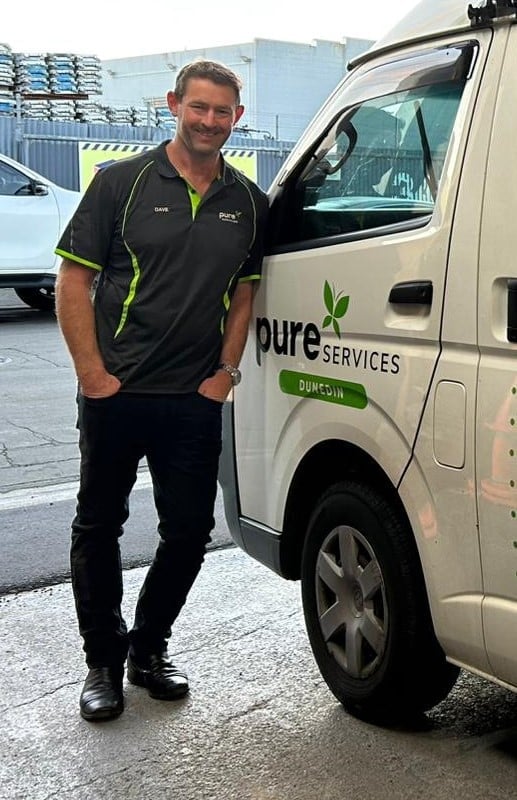
We look at dyslexia as another tool in the toolbox
A message of hope
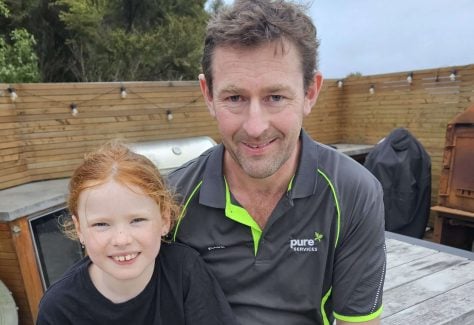
Dave and his wife Sarah have a 9-year-old daughter, Maggie, who was recently diagnosed with dyslexia through SPELD NZ — and they couldn’t be more optimistic. She’s getting support much earlier in life than Dave did, plus she has a family who champions dyslexic thinking in the workplace and creates an environment that enables the neurodiverse to thrive.
“In today’s world I see dyslexia as a massive advantage and something that should be explored and celebrated,” says Dave. “As a parent I absolutely recognise the challenges it brings during the schooling years but outside of that, it can open up incredible opportunities.
“From my early experience as a parent of a child with dyslexia, the best thing you can do is talk openly about it, embrace the challenges it poses and don’t lose sight of the positives!”